
Chapter I: The doll on the shelf
By the late 1990s, our house was rarely quiet.
Four little children filled every room with movement. Tiny shoes gathered by the front door. Toys appeared almost as quickly as I could put them away. Someone was always laughing, crying, hungry, tired, or looking for me. My days were spent buttoning little shirts, wiping sticky faces, folding laundry, tying shoes, cutting sandwiches into bite-sized pieces, and settling the endless little disagreements that seem so important when you’re three.
By the time evening came, I usually fell into bed exhausted, only to wake up the next morning and do it all again.
I loved it.
If someone had shown me that life when I was a little girl, I don’t think I would have believed it could ever belong to me.
My mother had been gone for several years by then. Most days, I stayed too busy to think very long about the empty place she had left behind. The children needed breakfast. The laundry kept growing. Life kept moving.
Then one afternoon, while I was walking through Kmart, I saw a rag doll sitting on a shelf.
I stopped without thinking.
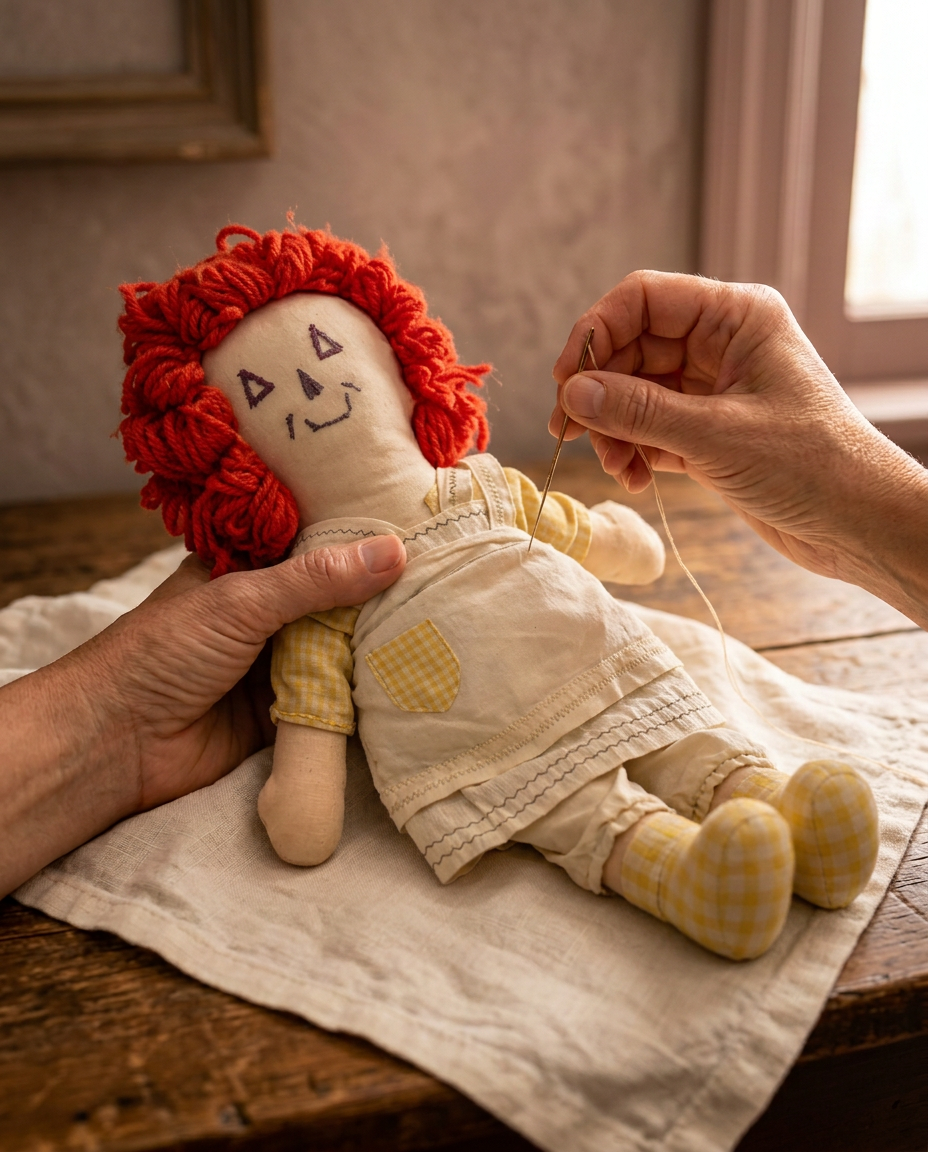
She had bright red yarn hair, a stitched smile, and a soft cotton dress. I stood there staring at her as tears slowly filled my eyes.
For a moment, I wasn’t standing beneath the fluorescent lights anymore. My mind began to wander back in time. It was as if I was transported back to 1990 again.
Chapter II: Three cardboard boxes
I was nineteen years old. I had just finished my first year of college and aged out of foster care without a permanent place to call home.
For a while, I drifted from one couch to another, staying with former foster families and friends whenever someone had room for me. No one ever asked me to leave, but I was always aware of how long I had been there. Every welcome felt temporary, and I never wanted to become one more burden in someone else’s home.
When there was nowhere else to go, my yellow 1974 Volkswagen Bug became home.
Everything I owned fit into three cardboard boxes. At night, I slid them onto the front seat so I could curl up in the back. There wasn’t enough room to stretch out, but after a while I stopped expecting comfort. I was just grateful to have somewhere to park.
During the day, I became good at looking like everything was fine. I went to work. I smiled when people spoke to me. I kept my clothes clean and brushed my hair before every shift. I learned which gas station bathrooms were clean enough to wash up in and where I could park at night without attracting attention.
But after the sun went down, pretending became harder.
The windows fogged with my breath. The air turned cold before morning. Every sound seemed louder than it should have. A car door closing somewhere nearby. Footsteps passing a little too close. Shopping carts rattling across the parking lot. I slept lightly, waking at the smallest noise, never quite forgetting how alone I was.
The three cardboard boxes stayed beside me every night.
Inside were letters my mother had written from prison, yearbooks filled with signatures from classmates I wondered if I would ever see again, photographs, and little pieces of a life that already felt farther away than it should have.
Resting on top, wrapped in a blanket, was the rag doll my mother had sewn while she was incarcerated.
Her red yarn hair had begun to come loose, and the elastic in her little bloomers had long since stretched out. But her stitched smile was exactly as I remembered it.
She was the most valuable thing I owned.
Every night, before I could climb into the back seat, I had to move the boxes. I handled them carefully, making just enough room to curl up and sleep. In the morning, I slid them back into place before heading to work.
I rarely opened them.
I didn’t need to.
I knew what was inside.
Once in a while, I would lift the lid just long enough to see my mother’s handwriting on an envelope or run my fingers across the cover of a yearbook. Then I would close the box again and get on with the day.
That summer, I was in my final year of eligibility for the summer youth program, and the job became one of the few steady parts of my life. Every morning, I showed up on time, determined that no one would discover where I had spent the night.
Eventually, my supervisor, Kathy, did.
She didn’t ask a hundred questions or tell me what I should have done differently. She simply opened the door to her apartment and invited me in.
For the next month, I traded the driver’s seat of my Volkswagen for a bed.
The first night, I lay awake for a long time. Not because I was afraid. Because I wasn’t.
I remember the quiet more than anything else. The soft hum of the refrigerator. A lamp glowing somewhere down the hall. The ordinary sounds of someone else’s home settling in for the night.
For the first time in weeks, I stretched out without my knees pressed against the side of a car. I don’t remember exactly when I fell asleep. I only remember waking up the next morning feeling rested.
Living with Kathy gave me enough breathing room to think about what came next. Before long, it was time to return to college, and I wanted more than anything to leave that summer behind.
The three cardboard boxes had followed me everywhere. They had ridden beside me in my car, sat in borrowed bedrooms, and waited patiently while I tried to figure out where I belonged. Looking at them, I saw memories I wasn’t ready to carry anymore.
Before I left Kathy’s apartment that summer, I carried the three boxes outside and set them beside the trash bin. Then I walked away, hoping to leave that life behind and begin a new one.
I believed the only way to find a different life was to leave the old one behind.
Chapter III: The call
Standing in the aisle at Kmart, looking at that little rag doll, I would have given anything to hold mine again.
I left Kmart in tears.
That night, after the children were asleep, I lay awake replaying everything I had thrown away. My mother’s letters from prison. My yearbooks. Family photographs. The rag doll.
When I finally fell asleep, I woke again before morning and nudged Dale awake, asking if he would pray for me.
He took my hand without hesitation. He prayed that God would give me peace, quiet my heart, and help me let go of the regret I couldn’t seem to escape.
I wanted to believe that would be enough.
I tried to keep my mind busy, hoping the regret would fade with time.
One afternoon, I stopped to visit my friend Don, who was involved in street ministry in our community. He introduced me to a woman named Nancy. We talked for a few minutes before I went on my way. It was a pleasant conversation, but there was nothing about it that seemed unusual.
The following afternoon, the phone rang.
“This is Kathy,” the voice said. “You may not remember me, but you lived with me during the summer of 1990.”
I knew her voice immediately.
For a moment, I couldn’t speak.
I hadn’t heard from her in years. I thought about her apartment, the bed she had given me, and the kindness she had shown a frightened nineteen-year-old who had nowhere else to go. Then I thought about the three cardboard boxes I had left behind.
“How did you find me?” I finally asked.
She laughed softly.
“You met my best friend yesterday,” she said. “She told me about someone she’d talked with, and before she finished, I knew it was you. I’ve been trying to find you for years.”
Then she said four words I never expected to hear.
“I have your boxes.”
I was silent. In shock. Wondering if was really hearing her words.
“I have your boxes,” she said again.
She told me she had found them beside the trash bin all those years before. She brought them inside and kept them, believing that one day I might come back for them.
I fell to my knees in tears, just as I had the night I lost my mother.
The first time, my world had fallen apart.
This time, something precious had been restored.
Chapter IV: Restored
I drove to Kathy’s house as soon as I could.
She met me at the door with a smile, then disappeared for a moment before returning with three worn cardboard boxes.
I recognized them immediately.
The tape had yellowed with age. The corners were soft and worn from years of being moved from one place to another, but they were the same boxes I had carried in and out of my little Volkswagen so many nights before.
For a long moment, I just stood there looking at them. Then I knelt down and opened the first box. Everything was exactly where I had left it.
Wrapped carefully in a blanket was the rag doll my mother had sewn while she was in prison. I lifted her out as gently as if she might break. Her bright red yarn hair had thinned in places, and the elastic in her little bloomers had long since given out, but her stitched smile hadn’t changed. Neither had the feeling that washed over me as I held her.
I cried harder than I had cried in years. For so long, I believed I had thrown away the last pieces of my mother. Instead, someone had quietly protected them for me.
I looked over at Kathy and tried to thank her, but the words caught in my throat. How do you thank someone for saving a part of your life you thought was gone forever?
I don’t remember everything we talked about that afternoon.
I remember the boxes.
I remember the doll in my hands.
And I remember driving home with all three boxes beside me, glancing at them every so often as if I needed to make sure they were really there.
For years, I believed I had destroyed the last pieces of my childhood. I hadn’t. God had quietly been preserving them until I was ready to receive them again.
The letters.
The yearbooks.
The rag doll my mother had sewn with her own hands.
He didn’t just return a few old belongings.
He reminded me that I had never been forgotten.
Looking back, I realize that day was never just about the boxes.
It was the first unmistakable reminder that God had been writing a different ending to my story all along.